FTP Clients - Part 15: WebDrive
30 November 2014 • by Bob • FTP, SSL
For the next installments in my series about FTP clients, I will be taking a look at two FTP redirectors at the same time. In this specific blog post, I will focus on WebDrive (from South River Technologies), whereas my next post will look at NetDrive (from Bdrive Inc.).
At the time of this blog's writing, WebDrive is a for-retail FTP client and redirector which is available from the following URL:
For this blog post I will be using WebDrive version 12.10.4082.
WebDrive 12 Overview
Before I continue, I would like to begin with some background information: because of my ongoing blog series about FTP clients, one question that I have often been asked is, "Which FTP client do you use?" Usually I have to answer, "That depends." I know that my answer sounds non-committal, but to be honest - I have yet to find an FTP client that does everything that I want, although a few FTP clients have had enough features for me to use them quite often. And with that in mind, I need to point out that I purchased my first license for WebDrive over 12 years ago, and over the years I have periodically renewed my license for later versions. So to partially answer my earlier question - WebDrive is one of the FTP clients that I have used a lot.
That being said, WebDrive is different from many of the other FTP clients that I have reviewed because it is an Internet protocol redirector, meaning that it allows you to map drive letters to a variety of Internet-based repositories. (I'll discuss those various protocols and repositories shortly.)
When you install and open WebDrive, you are presented with a fairly empty user interface:
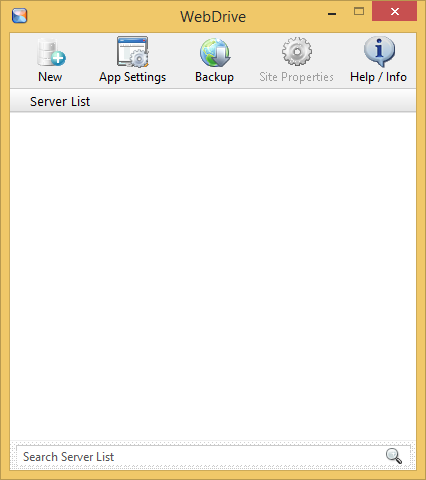
If you click the App Settings icon, you will be presented with a dialog box that offers dozens of customizable options:

When you click the New icon, you will be presented with a Site Wizard which lists the supported Internet protocols and repositories which you can use for mapping drives:

As you can see from the illustration above, WebDrive's list of support technologies is quite extensive: WebDAV, Secure WebDAV, FTP, Secure FTP, Google Drive, Amazon S3, SFTP, Dropbox, and FrontPage Server Extensions.
When you choose to create an FTP connection, WebDrive launches its Site Wizard, and the initial dialog box is pretty self-explanatory:
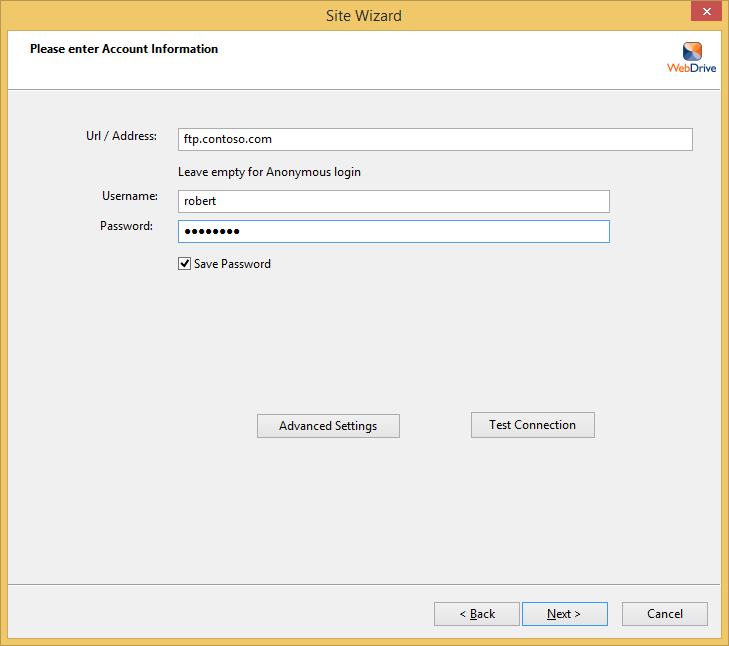
However, when you click the Advanced Settings button, you are presented once again with dozens of customizable settings for this specific connection:

As you continue to add sites with WebDrive, their connection types and current statuses are displayed in the user interface:
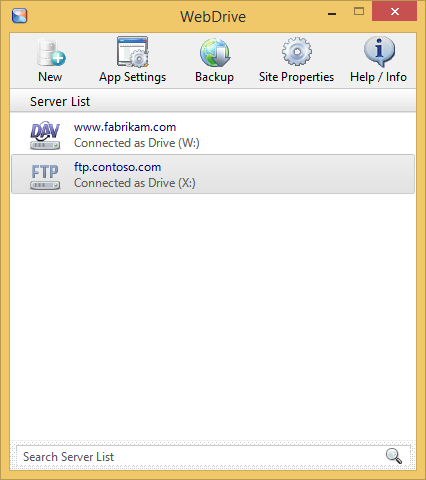
However, when you view your drives in Windows Explorer, even though network drives which are mapped through WebDrive are displayed with a different icon, you cannot tell the protocol type for mapped drives; this is one of the few times where NetDrive supported a feature that I really missed in WebDrive. (See my next blog entry for more information.)

WebDrive 12 supports command-line scripting, so if you find the features of the built-in Windows FTP client are somewhat limited, you can investigate scripting WebDrive:
WebDrive Command Line Parameters
I would love to take an in-depth look at all of the supported protocols in this review, but this series is about FTP clients, so I'll move on to the FTP-specific features that I normally review.
Using WebDrive 12 with FTP over SSL (FTPS)
WebDrive 12 has built-in support for FTP over SSL (FTPS), and it supports both Explicit and Implicit FTPS. To specify which type of encryption to use for FTPS, you need to choose the appropriate option from the Security Type drop-down menu in the FTP Settings for a site:

Using WebDrive 12 with True FTP Hosts
True FTP hosts are not supported natively by WebDrive 12, and there are no settings that I could find which would allow me to customize the login environment in order to work around this situation.
Using WebDrive 12 with Virtual FTP Hosts
WebDrive 12's login settings allow you to specify the virtual host name as part of the user credentials by using syntax like "ftp.example.com|username" or "ftp.example.com\username", so you can use virtual FTP hosts with WebDrive 12.

Scorecard for WebDrive 12
This concludes my quick look at a few of the FTP features that are available with WebDrive 12, and here are the scorecard results:
| Client Name | Directory Browsing | Explicit FTPS | Implicit FTPS | Virtual Hosts | True HOSTs | Site Manager | Extensibility |
|---|---|---|---|---|---|---|---|
| WebDrive 12.10.4082 | N/A | Y | Y | Y | N1 | Y | N/A |
Notes:
|
|||||||
That wraps things up for today's review of WebDrive 12. Your key take-aways should be: WebDrive is a powerful redirector with support for a wide variety of protocols. What's more, the WebDrive application and each individual connection contain dozens of options which allow you to customize the environment in hundreds of ways. As is the case with many of my reviews, I have barely presented a fraction of the capabilities that are available in WebDrive 12; you might want to try it out and experiment with all of its possibilities.
Note: This blog was originally posted at http://blogs.msdn.com/robert_mcmurray/
In Memoriam: Kenny King
28 November 2014 • by Bob • Family
On Tuesday morning, October 28, 2014, my good friend Kenny King passed away after a long battle with cancer. Kenny was a loving father and husband, and he had been one of my closest friends for almost 20 years. I was honored to speak at his memorial service, and I wanted to share the notes that I used during the service.
Proverbs 18:24 teaches us that, "One who has unreliable friends soon comes to ruin, but a true friend sticks closer than a brother (ISV/NIV)." Matthew Henry explains this verse in his Commentary on the Whole Bible in the following way: "In our troubles we expect comfort and relief from our relations, but sometimes there is a friend, [who is unrelated] to us, the bonds of whose esteem and love prove stronger than those of nature, and, when it comes to [trials], will do more for us than a brother will." I cannot think of a better way to describe my relationship with Kenny King, for even though I have a younger and older brother by birth, they were stuck with me against their will; whereas Kenny adopted me by choice.
Kenny and I met in December of 1995 when he and I were hired by Microsoft in Tucson, Arizona. We were hired the same day, and our employee IDs show that he was technically hired six people before me. (Because of this, Kenny loved to point out that he had an hour or so of seniority over me.)

We were both hired as part of a newly-formed team which was to provide technical support for the same Microsoft products, so we went through all of our "New Hire Training" together. And it was there that I learned several important things about Kenny.
First of all, I learned that Kenny knew all of the best places to find Mexican Food in Tucson. He would organize team lunches, and he would lead a group of trusting coworkers to some of the strangest, hole-in-the-wall eating establishments which I would never have discovered on my own; yet he could convince everyone that we were going to be fine.
Which brings me to the next thing that I learned about Kenny: for those of you who never saw Kenny at work, he had a superpower - Kenny was an amazing leader. It never ceased to amaze me that you could throw a dozen people in a room with a problem to solve, and somehow Kenny would wind up being the guy at the whiteboard putting the plan together. He never asserted his role as a leader; people naturally wanted to follow him.
But I also learned that Kenny had a rather interesting sense of humor, and let me explain by example: in the first few days of training for phone support, we were required to go through several "Role Playing" exercises in front of our peers, where one person would coach another person through a common task (like making a sandwich). I was assigned to talk Kenny through the process of changing a tire, and I coached him through locating his tire iron, raising the car with the jack, and removing the tire. Everything seemed routine, but suddenly Kenny started yelling, "Oh no! My car is rolling backwards! You forgot to tell me to set the emergency brake! My car just crashed to the ground! Where's your manager?" Some people in my situation would have been horrified, some would have been offended, and others would have been furious - but I thought Kenny was hilarious. And at that moment, I realized that he and I were going to be great friends.

Kenny and I worked together for a couple months, but then I quit the team in order to help create another support team which was working on cutting-edge products for this new-fangled thing called "The Internet." As part of my new responsibilities, I was setting up several UNIX-based servers in a lab, and since my UNIX skills were a little rustier than Kenny's, I would ask him to drop by and help out. After a few days of "borrowing" Kenny for his expertise, my colleagues and I decided that it would be better to just "steal" Kenny. We gave him no choice in the matter; we simply told Kenny that he now worked with us, and he agreed to it. This proved to be a fortuitous change for both Kenny and me, because a few months later the products for our newly-formed team were some of the fastest-growing technologies in Microsoft.
Shortly after our one-year anniversary with the company, life handed us an interesting predicament: Microsoft announced that it was closing the support site in Tucson, and we needed to find other jobs within the company. Because our products were in such high demand, we had our choice of locations. With that in mind, (and I am somewhat ashamed to admit this publicly), the first person I asked - even before my spouse - was Kenny, because I wanted to see where he wanted to move. Kenny replied, "I don't know - where do you want to move?" And that was the humble beginning of a plan the two of us hatched which brought us to Texas. (I moved here first, and Kenny arrived a few days later, so I claimed that I had seniority in Texas.)
Believe it or not, Kenny and I came up with the following proposal: since Microsoft would give each of our families a one-bedroom apartment for a single month as temporary housing, we asked Microsoft if we could combine our benefits and move our two families into a two-bedroom apartment for two months. This meant moving our wives (who had never met) and our four children (who had never met) into 1,000 square feet of space for sixty days. Kenny and I thought that if we were such great friends, then our wives would get along, too. (We're guys - we can be stupid like that.) But as it turns out, our families did get along, and the group of us became great friends. We eventually bought houses around the corner from each other in Lewisville where we were neighbors and our kids grew up together. Kenny and I often carpooled to work when we were on the same team, and our families spent countless days passing back and forth between our two houses for birthdays, barbeques and holidays.

My wife and I became members of Grace Community, and we brought Kenny and Gloria to a variety of church events. It was on those occasions where people like Pastor Richard and Ladonna and a score of other wonderful people loved on Kenny and Gloria and their family so much that they couldn't help but fall in love with Grace, and they eventually became part of this congregation, too.
When Microsoft moved my wife and me to Seattle several years ago, our oldest daughter, Rebecca, was completing her degree at TWU in Denton, so she chose to stay here in Texas, and she moved in with Kenny and Gloria for about a year. Kenny became a second dad for Rebecca, and it is with extreme gratitude that I tell you that Kenny's wisdom and encouragement helped shape the person my daughter has become.
As most of you know, Kenny had several great passions in life: Christ, his family, fishing, golf, and - of course - the University of Arizona. When I moved back to Tucson last year, I began taking graduate classes at the U of A, and as I walked around campus, I started sending Kenny photos from various U of A landmarks with innocuous statements like, "Guess where I am and you're not?" and "Wish you were here?"

In the weeks that followed, I began to call Kenny every week or so when I had a break between classes to catch up on life. (Since the U of A mascot is the Wildcat, I would refer to our conversations as "Kenny's Weekly Cat Call.") We discussed a variety of topics, and when Kenny was diagnosed with cancer, our conversations naturally turned to discussions about his treatments and his health. But the subject that Kenny discussed the most was his family:
- KJ, Kyle, and Keynan - please believe me when I say that your dad was so proud of the three of you. Every week he filled me in on every detail of your lives, and you should never doubt how much he loved you all.
- Gloria - it was always evident to everyone who knew Kenny that you were the most-important person in his life, even though he sometimes told people that he was the most-important person in your life.

A verse that I have been reminded of these past few days is 1 Thessalonians 4:13-14: "Brothers and sisters, we do not want you to be uninformed about those who sleep in death, so that you do not grieve like the rest of mankind, who have no hope. For we believe that Jesus died and rose again, and so we believe that God will bring with Jesus those who have fallen asleep in him. (NIV)" Because of Kenny's faith in Christ, I know that we will see him again, but for now my heart has a tremendous hole in it which only Kenny could fill.
Kenny was one of my closest and dearest friends, and I miss him terribly. And yet I have to remind myself that it is only my personal self-interest that wants Kenny here, for Kenny is where God called him to be. Gloria mentioned last week - and please forgive me for paraphrasing - that she knew Kenny would be healed completely, even if it was not during his time on earth. So I am thankful today that Kenny has been healed, and I look forward to being reunited him when God calls me home. Although God called Kenny before me - so Kenny will probably claim that he has seniority.
Ride Notes for El Tour de Tucson 2014
22 November 2014 • by bob • Bicycling
So today I rode 104 miles in the 32nd Annual El Tour de Tucson, for which I had been training for the past five months. By way of explanation, El Tour is an annual bicycle race held in Tucson to raise money for charities. (This year's event apparently raised $7,000,000 for a variety of charitable organizations.)
 |  |
I began training for this ride at the beginning of July, and since that time I have ridden an average of 80 miles per week, for a total of 1,500 miles. That being said, I still wasn't sure until a week ago if I would go on this ride, even though I remained committed to training as though I was going. What's more, if I was going to go, I couldn't decide whether to go on the 75-mile or 104-mile ride. The furthest that I had ever ridden was 75 miles, and that was the previous week, so I had doubts as to whether I could complete the 104-mile route.
On the last day of registration, I finally made up my mind - I decided to go, and I registered for the full distance, which encircles the city of Tucson.

On the night before the ride, I stayed up late - which should be no surprise for anyone who knows me - although I had originally intended to head to bed early in order to have plenty of rest before the ride. But I stayed up late writing an application for my Windows Phone that tracked my location using the phone's GPS system and uploaded my location to a website that I set up for the race. (By using this application, Kathleen was able to watch my progress on her laptop as I raced around the city.)

Before heading off to bed, I went over my pre-cycling list that I had created after I had forgotten to bring my water bottles on a ride a few weeks ago. This was quite helpful, and after I had all of my usual things together, I made my final decisions for which specialty gear I was bringing with me. I knew from the weather forecasts that it was going to be very cold in the morning, and one of my cycling friends here in Tucson had lent me a bunch of cold weather cycling gear. With that in mind, I knew that I would have to carry anything that I brought with me for the duration of the ride, so I needed to balance staying warm before and during the ride with the limited space in the pockets of my riding jersey.

I eventually decided on a light jacket (which I could remove before the ride), a vest and a baklava (which I could remove once it warmed up), my pull-over sleeves (which I can pull down during the ride), and knee covers (which I could remove if necessary). My friend had advised me to only bring two water bottles with me and to refill at the various stops along the way. This would save on weight, but since I got my seat-post-mounted dual water bottle holder working earlier in the week, I chose to bring four water bottles and bypass all of the stops. Once I had everything ready for the ride, I climbed into bed around midnight.
I woke up at 2:00am, which was only two hours after I had gone to sleep, and for some reason I was unable to get back to sleep. I had my alarm set to wake me up at 4:30am, but by 4:00am I decided that any efforts to lose consciousness were going to be fruitless and I reluctantly got up. Since I had packed everything before going to bed, I just had to load everything into car and head out across town. (Along the way I dropped by a McDonald's to pick up an egg white McMuffin for breakfast.) The outside temperature was 45 degrees, so I decided to acclimatize during the drive by opening up the car vents and turning on the cold air in the car. My teeth chattered the whole way, but I knew that it was going to get worse when waiting for the ride to begin.
I arrived at the Tucson Community Center (TCC) in Downtown Tucson shortly before 5:00am. I chose to park at TCC because it's around the corner from Armory Park, which was the start and finish line for the race. There were several other cyclists getting their bicycles ready as I pulled into a space in the TCC parking lot, and once I packed my gear for the day onto my bicycle, I rode over to Armory Park to get in line.

Cyclists in the race are lined up by category: Platinum riders must have completed the ride in less than five hours in previous races, and riders in that group need to have a VIP pass that designates their Platinum status. Gold riders complete the ride in five to six hours, Silver riders complete the ride in six to nine hours, and Bronze riders complete the ride in nine hours or more. With that in mind, I knew that I would never qualify for Platinum, but I might qualify for Gold. I normally average just under 17 miles per hour for my distance rides, and completing 104 miles in six hours would be a small fraction faster than my usual pace. The El Tour event guide said that people begin lining up for the Gold category around 3:30am, and by the time that I pulled into line around 5:00am there were several hundred riders already queued.

The line of cyclists in front of me around 5:20am.
Just by coincidence I got in line next to a couple of cyclists who have been riding with the folks from Sabino Cycles. We recognized each other, so we spent the next couple hours chatting before the ride began. As the morning progressed, an announcer began describing the schedule for the ride. He informed us that around 9,000 riders had registered for El Tour, with around 2,700 riders for just the 104-mile ride.

The line of cyclists behind me around 6:15am.
It was bitterly cold for most of the time we were waiting, but everyone was thankful that it wasn't raining like it was for the previous year's El Tour. But still, the temperature was around 35 degrees for much of my time in line, even as the sun was slowly rising in the East. (See the Ride Statistics later in this blog for the final temperatures.)
As the time approached for the race to start, all of the cyclists began to shed layers of clothing, so I folded up the jacket that I was wearing and packed it away in one of my jersey pockets. Some of the other cyclists were wearing "disposable clothing," which was an interesting discovery for me; apparently clothes that are left near the starting line are gathered and donated to charity, so a bunch of cyclists wore clothes that they intended to donate, and they tossed those aside before the ride.
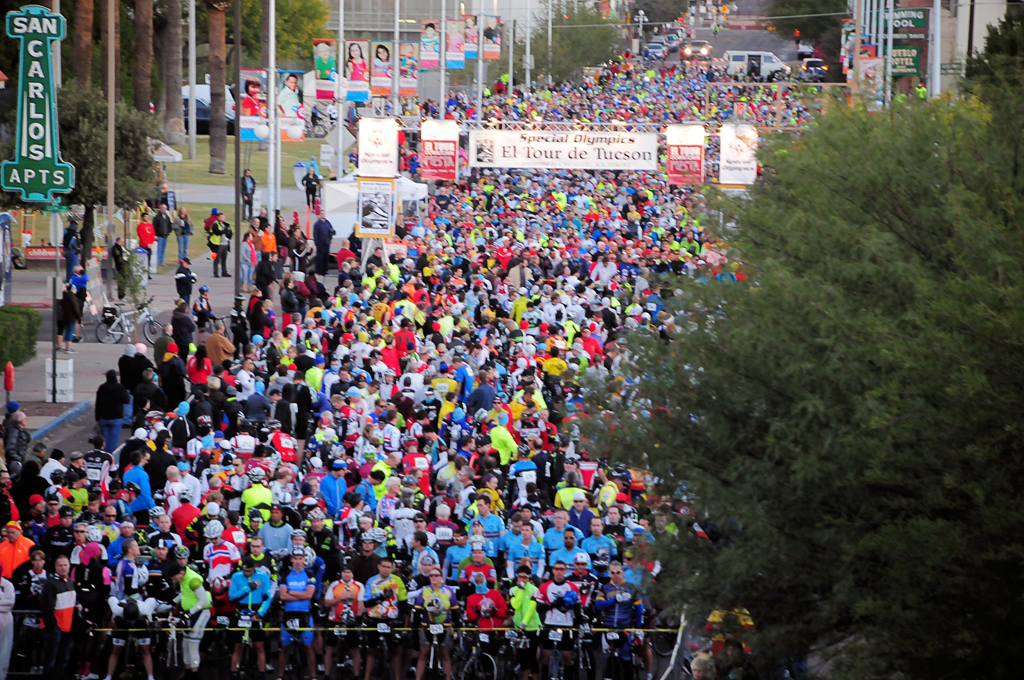
In the last few minutes before the race began, the announcer introduced the Mayor of Tucson, who helped count down the time to the race start. In the final few seconds, I quickly pressed the start button on my Garmin GPS and I launched the GPS application that I wrote the night before so Kathleen could keep track of my progress during the ride. As the race began, we all looked like a bunch of penguins as we collectively waddled our way up to speed, and then I was savagely amused as I heard the sound of hundreds of cycling cleats locking into their pedals and the beeps from dozens of GPS devices starting up as we collectively took off in a massive sea of cyclists.
Video from the start of the race.
(Note: I go speeding by at 0:53 in blue and yellow.)
I was concerned that the start of a race with thousands of cyclists would be chaotic, but it was actually very organized; I guess most of the other riders were just as concerned about not hitting someone else as I was. That being said, within the first couple miles the knee warmers that I was wearing had fallen down to my ankles, where they remained for the rest of the ride.
I started out at a great pace - averaging 19 to 20 mph, even though I knew that I still had a lot of riding to do. This was painfully obvious to me, because I was continuously calculating how many miles I had left. (I started my calculations during the first mile.)
A little over 20 minutes into the ride we hit the 7-mile mark, which was the first of two river crossings that require all cyclists to dismount and carry their bicycles across through the sand. (Thankfully the river was dry.)

Lugging my bicycle up the far side of the river.
(Notice how red my knees were from the cold, while
the knee warmers were uselessly hugging my ankles.)
The race organizers added a nice touch for the experience - a large mariachi band was playing on the opposite side of the river, which was a lot of fun.

The next 22 miles were pretty straight-forward - we rode the long way around the south side of the Tucson Airport, then along the frontage road south of I-10, and then around the Air Force Base. I was 1 hour and 45 minutes into the race when I reached the Pima College East Campus, which meant that I was passing the campus 15 minutes after the riders had started the 75-mile race. This made me think, "Wow - if I had decided to do the 75-mile ride, I would be just starting out, instead of having completed 30 miles of riding after two hours of freezing."

To help alleviate my self-misery, there were dozens of well-wishers cheering us along. Actually, there were hundreds of spectators shouting encouragement for most of the race, and the Tucson Police Department was nicely blocking off traffic for cyclists.
After I made it past the college, I faced one of the first real challenges of the ride: we had to ride up the steep hill on Houghton road past McGraw's Cantina, then we continued to climb the hill along Escalante road to the highest point in the race.

After that, we turned past Saguaro National Park and headed down Freeman road, all of which was coincidentally in my part of town. As evidenced by my blogs, I ride through this part of town quite often, so I made up for time lost during the hill climbs by speeding down Freeman road as fast I was comfortable. (Which I prefer to be less than 30 mph.)

After riding down Freeman, the route took us down Houghton to Snyder, which quickly led to the second river foot crossing over Sabino Creek. Once again, the race organizers had hired a mariachi band to serenade the pack of weary cyclists as we made our way through the dry creek bed.

A group of friendly volunteers was handing out water and sliced fruit as we arrived on the opposite side of the creek, but I strolled past all of that so I could get back on the road as fast as possible.

After I got back on the road, we faced a short-but-serious climb up Snyder road. As I was slogging my way up the hill, the cyclist next to me exclaimed, "It's a good thing this climb is so short!" To which I whole-heartedly agreed. As we started down the far side of the hill, I saw a cyclist wipe out badly in my peripheral vision; the accident sounded terrible, but I'm not the kind of person who feels compelled to look, even though the other cyclists around me craned their necks to see.

I should point out that I spent most of the race as a solo rider. I would often pass a group of cyclists or solo rider, only to have them pass me a few miles later, or they would pass me and then I would pass them. Either way, I would repeat this scenario with other groups of cyclists or solo riders throughout the day; no one seemed to be riding my same pace throughout, and I couldn't find a good group where I was comfortable for the whole ride. There may have been wisdom behind some of the groups' decisions to negotiate parts of the course at a slower pace, but I can't be sure.

As I passed the 50-mile mark, my left calf felt like it was forming a charley-horse, and I thought to myself, "Oh no... this cannot happen. Not today." But I kept pedaling anyway, and eventually it seemed to work itself out. This was great, of course, because a charley-horse could have ended my ride. (And I would have had to try and figure out how to get home since I drove our only car to the starting line.)
As I pulled onto Sunrise Drive, I was thankful that I had ridden that route several times before, so I knew what to expect - there's a big hill just past Kolb road, and several more hills before reaching Swan road. Once we reached Swan, we were treated to 13 miles or so of mostly downhill riding, and I took advantage of the time to make up for some of the time that was lost during the hill climbs.

One thing that helped greatly during the ride was the recent addition to my riding arsenal of an Ivation Beacon, which is a Bluetooth-enabled, bicycle-mounted speaker. With this in mind, I brought an interesting mix of music with me: I had several songs from well-known artists (Eric Johnson, Joe Satriani, King's X, Extreme, Rush, Sammy Hagar, The Who, and Van Halen), but I also had a mix of less-known artist that I like (Angelica, Dave Beegle, Gary Hoey, Gideon's Press, Neil Zaza, Novella, Paul Gilbert, Stavesacre, etc.) Listening to music helped me to keep from focusing on how much pain I was in; my muscles were aching, of course, and my road bike has no way to dampen the bumps and cracks in the road, so I was taking a lot of abuse throughout the race; I can't think of how difficult the ride would have been without some good music to keep me company.
As I pulled onto La Cañada, I faced four miles of climbs. According to the ride profile, this was supposed to be the steepest climb of the race, but to be honest - it didn't seem that different than most of the other steep climbs. (Although it still wasn't fun, of course.) While I was riding through this part of the course, I started doing the math, and I realized that it would be nearly impossible for me to make the Gold level for the ride. Nevertheless, I continued pushing toward my goal pace.

Showing faux enthusiasm for the
ride despite the pain and exhaustion.
After I pulled onto Moore road, I was treated to ten miles of gradual downhill riding. I can't lie, after 70 miles, that was a really nice change of pace. I tried my best to duck my head down and pedal hard, but my right upper arm was really starting to hurt, so I couldn't stay in that position for long.
When I got to I-10, I began the long, 25-mile, continuous uphill climb to the finish line. I knew about the climb from having studied the route profile before the ride, but knowledge of the gradual climb was even more demoralizing when I realized that I was in Marana. For 20 miles or so the route followed the frontage road to the west of the interstate; this may have significantly reduced the number of traffic lights, but for the first time in the race I actually had to stop for traffic lights. The police officers assigned to the race course were doing their best to prevent cyclists from having to stop, but I was often riding alone, and solo riders were usually forced to stop until a larger group of cyclists arrived. Just the same, many of the cyclists (including me) tried their best to thank all of the police officers who were directing traffic for us.
My registration number for the race was 2621, and numbers were assigned depending on the length of the ride for which each rider had registered. (Riders who registered for the 104-mile ride were assigned numbers 1 through 3999, riders for the Fun Ride were between 4000 and 4999, riders for the 75-mile ride were between 5000 and 5999, riders for the 55-mile ride were between 6000 and 7999, and riders for the 40-mile ride were between 8000 and 9999.) The tags that riders were required to pin to the backs of their riding jerseys were also color-coded, which meant that you could quickly tell which length any rider was travelling. (104-milers were white, 75-milers were yellow, 55-milers were green, and 40-milers were blue.) Of course, this meant that as I neared the end of the race, I would see a rider from the 55-mile or 40-mile race passing me, and I would comment under my breath, "Oh yeah? I've been riding for twice as long and twice as far, so suck it, dude."

Notice the long hair flying in the breeze...
As we approached downtown Tucson, the race route departed the frontage road, and after a quick jaunt around the base of "A" Mountain on Mission road, we turned onto 22nd street and headed east into Tucson. My GPS showed that I had passed the century (100-mile) mark, so I knew that my part of the race would soon be over. Nevertheless, the ride along 22nd was terrible; large splits in the pavement had most of the cyclists cursing this part of the ride.
As I turned north onto 6th avenue, I could soon see the finish line ahead of me, which was a welcome sight; there's something about seeing the light at the end of the tunnel that gives you an adrenalin boost.

Riding the last few hundred yards to the finish.
A group of cyclists were clustered at the finish line as race workers were marking the numbers on each riders' jersey with their final race standing (Platinum, Gold, Silver, etc.) While I had hoped for Gold (under 6 hours), I realistically expected to finish the ride in 7 hours. With that in mind, having finished the race in 6 hours and 17 minutes of continuous pedaling was a time that I could be happy with.

Walking away from the finish line.
(Amazingly enough, my legs still worked.)
After I exited the race course, I found my way through the myriad tents that were set up throughout Armory Park to the area where they handed out the medals for each rider. Oddly enough, all of the medals appeared to be bronze - only the lanyard for the medal listed the actual Platinum, Gold, Silver, or Bronze standing.

Once I picked up my medal, I noticed that I had received a text message from Kathleen congratulating me for having completed the race. It seems that my Windows Phone application had worked perfectly for the duration of the ride, so Kathleen had been tracking my progress and knew that I had just finished.

I wandered over to the tent for Sabino Cycles, where I said "Hi" to a few folks that I knew, and I had a few of the snacks that they were graciously providing for cyclists. One of the cyclists at the Sabino Cycles tent was one of the guys with whom I had been waiting that morning; we had seen each other periodically during the day, although we never seemed to be riding the same pace, and he crossed the finish line a few minutes after me. I asked another of the riders whom I knew from my Saturday morning rides to take a quick photo for me to send to Kathleen.

The race is over, so now the smile is real.
After a few minutes of visiting with a few folks, I hopped back on my bicycle and rode back to the TCC parking lot, where I packed my gear into the car and started the long drive back to the east side of Tucson where Kathleen and I live.
Ride Stats:
- Primary Statistics:
- Start Time: 6:59am
- Distance: 104 miles (102.6 miles on my GPS)
- Duration: 6:17:15 (6:15:06 on my GPS)
- Calories Burned: 2729 kcal
- Altitude Gain: 3173 feet
- Speed:
- Average Speed: 16.4 mph
- Peak Speed: 31.4 mph
- Average Cadence: 83.0 rpm
- Temperature:
- Average: 51.2 F
- Minimum: 32.0 F
- Maximum: 68.0 F
- Heart Rate:
- Average: 149 bpm
- Maximum: 170 bpm
Ride Notes for November 18th, 2014
18 November 2014 • by Bob • Bicycling
There's really not much to say about today's ride: I went for my usual 17-mile ride from my house through Saguaro National Park and back home again. I was perhaps two minutes behind my fastest time for the ride, which wasn't too bad.

The training technique that I have been focusing on recently is keeping my cadence rpm between 80 and 90 and letting the mph take care of itself. At first glance that might seem to be be the cause of riding slightly slower than my fastest time, but to be honest – my final time was about average for my short rides, so I don't think that my cadence really played any part.
There were a few cars in the park today, but they all played nicely with cyclists and moved over when I needed to pass. (And thankfully no one had parked in the middle of the loop for a change.) There were also a few cyclists around the park, but they were mostly sightseeing so I didn't find anyone to ride with.
I was trying out a new seat-post-based dual water bottle mount today, (since my old seat-post-based mount failed miserably). This one seemed to be great, until I had ridden within a few miles of my house and I noticed that my water bottles were nearly horizontal. I quickly moved the water bottles into my jersey pockets and resolved to examine the mount when I got home, but it completely fell apart less than a mile from my house. Apparently the bolt which secured the water bottle cages to the main part of the mount had loosened during the ride, and it fell out completely as I neared home. (I pulled over to find all the pieces, which probably hurt my ride time.)
Ride Stats:
- Primary Statistics:
- Start Time: 2:41pm
- Distance: 16.9 miles
- Duration: 1:02:21
- Calories Burned: 638 kcal
- Altitude Gain: 823 feet
- Speed:
- Average Speed: 16.2 mph
- Peak Speed: 30.3 mph
- Average Cadence: 73.0 rpm
- Temperature:
- Average: 66.4 F
- Minimum: 64.4 F
- Maximum: 69.8 F
- Heart Rate:
- Average: 154 bpm
- Maximum: 173 bpm
Ride Notes for November 15th, 2014
15 November 2014 • by Bob • Bicycling
Today's ride resolved the question of whether I would be able to complete the 75-mile El Tour de Tucson which is rapidly approaching. This was really a two-part ride: I started out the day with a 36-mile group ride from Sabino Cycles, and then I continued on for another 39 miles as a solo rider.

For today's ride I wanted to make sure that I wouldn't be hitting the energy wall, so I made sure to pack lots of Gu and Clif bars for the ride, but I also switched from Gatorade to a drink mix from Cytomax for the ride. This drink mix contains a lot of the same electrolytes as Gatorade - with less sugar - but it also contains carbohydrates, so I'm replacing more of what my body is burning during the ride. Between the three of these items, I kept up my energy levels for the full 75-miles. (Of course, I was in pain from five hours of abuse when the ride was over, but I felt significantly better from nutritional standpoint.)
These past few weeks I have tried to go on the group rides with the good folks from Sabino Cycles; now that their rides start a little later (at 7:00am) I feel more inclined to go. (In the summers they start at 6:00am, which is waaaaay to early for me.) For this week's ride, they were starting from the store and riding west through town to Starr Pass, around the short loop at the resort, and then back to the store.
On our way westward I was the source of temporary entertainment: as we pulled up to a stop sign, I couldn't get my shoe out of the clip, and I fell over. I wasn't hurt - I'm actually pretty good about falling; I simply roll with the fall and I generally come out unscathed. Nevertheless, I laughed loudly at myself as I was lying in the street to let everyone else know that I was okay and that it was okay to laugh along with me.
There's not much else to say about the 36-mile ride: it was at a very slow pace, perhaps 12 mph or so. (I'm not sure why it was so slow, other than lots of stop signs and stop lights.) I met some interesting people along the way: I had a long discussion with a couple of guys who go to Calvary Chapel on the eastside, which is where Kathleen and I went to church for a while. I also met a C-130 pilot from the Air Force who looked to be around the age of my daughter Rachel; Tucson is her first duty station, and I told her that she moved to the perfect town for cycling.
Once the 36-mile ride was over, I stopped briefly at the car to swap out my two depleted water bottles for two more that I had ready-to-go, then I hopped back on the road. I followed something of my same route from last Saturday - I rode north on Sabino Canyon Road to Cloud, then east to Larrea, then north to the Canyon Ranch Estates.
During last week's ride I turned around when I reached the Canyon Ranch Estates, but I had been studying the maps for the upcoming El Tour de Tucson, which indicated a path through the Canyon Ranch Resort. With that in mind, I memorized the area and I rode that during today's journey - sort of. I missed a turn, and as a result I found myself slogging my way up Rockcliff Road, which has one of the worst climbs in the area. (Note: that part of the ride really, really sucked.)
After I had finished my misadventure on Rockcliff Road, I headed north on Sabino Canyon, then west on Sunrise to Swan, then south on Swan to River, and east on River to Craycroft. These past several miles resembled a lot of the previous week's ride, but when I arrived at Craycroft I hopped onto the section of The Loop that runs through Rillito River Park. I rode this trail westward all the way to Interstate 10, which is somewhere around 12 miles, and then I turned around and headed east back to Craycroft. My total time riding along the Rillito River Park was 1½ hours for 24 miles; that averages out to 16 mph, which is perfectly acceptable for that distance even though it is slightly below my average 17 mph pace for short rides.
Once I arrived at Craycroft, I headed east on River to Sabino Canyon Road, then south to the Sabino Cycles shop. When I pulled into the parking lot near the shop, my actual riding time was a few seconds over 5 hours, although my total time from start to finish was just over 5½ hours. (Note: the total time includes stopping for red lights, swapping out water bottles, lying on my side after falling over, etc.)
Ride Stats:
- Primary Statistics:
- Start Time: 6:49am
- Distance: 75.3 miles
- Duration: 5:00:13
- Calories Burned: 2187 kcal
- Altitude Gain: 2304 feet
- Speed:
- Average Speed: 15.1 mph
- Peak Speed: 29.2 mph
- Average Cadence: 78.0 rpm
- Temperature:
- Average: 59.9 F
- Minimum: 44.6 F
- Maximum: 73.4 F
- Heart Rate:
- Average: 142 bpm
- Maximum: 175 bpm
All Spiders Must Die
14 November 2014 • by Bob • Ponderings
One of my cousins posted the following chart to Facebook, and I think that most people would tend to agree with it:

Growing up in Arizona, I learned a simple rule for dealing with spiders: kill them all. Seriously. They all must die.
My philosophy for dealing with spiders was formed when we moved into a house on the northeast side of Tucson in 1978. At the time, our house was on the outskirts of the city, with little more than desert beyond our neighborhood. As a result, we had lots of creepy, crawly things roaming about. Between toxic spiders, toxic scorpions, toxic millipedes, toxic lizards, etc., we adopted an easy-to-remember motto for what was poisonous and what wasn't: "If it crawls, it kills." With that in mind, we generally killed anything that resembled an insect.
However, the worst of our lot was: an infestation of Black Widow spiders. I make no exaggeration - our house had hundreds of Black Widow spiders crawling about. As a paperboy, that meant checking very carefully when I exited the front door of our house around 5am every morning, because there were almost always 3 to 5 Black Widows hanging from webs in front of our door. If I didn't survey the area with due diligence, that meant that I would be wearing those Black Widows.

At first I used Raid or some other insect killer to dispatch my arachnid antagonists, but I eventually decided to use a can of Lysol and a lighter to create a miniature flamethrower. (Note: Do not try that at home.) Just in case you were wondering, Black Widows simply melt when you attack them with a flamethrower. (Which I found savagely gratifying.)
Jumping ahead a couple of decades, my wife and I moved to Seattle, Washington, where we purchased a house on a hill which backed up to a small forest. Part-way down the hill on our property was a small storage shed. We didn't need it for storage, so we decided to give the shed to our young son as a club house. With that in mind, one misty Seattle morning my son and I headed down the hill to the shed to clean it up for him.

As we pushed open the door, the musty odor from years of neglect and rotting debris was strong enough to force a hasty retreat from the average explorer. But we were determined, so we soldiered on. As we were cleaning out some of the accumulated rubbish from the shed, I noticed that the aging edifice had a drop ceiling, which was odd. Since it looked like the shed had been wired for electricity at one point, I decided to remove the ceiling panels and see what lurked behind them.
As I removed the first ceiling panel, I made a startling discovery: spiders. Millions of them. All shapes, sizes, and species. Some were crawling around, but most seemed to train all eight of their eyes on me as if to say, "Well, biped boy? What are you going to do about it?"

As I continued to examine the situation, one alarming fact became painfully clear: our storage shed was obviously the breeding ground for every spider in the Pacific Northwest. Recalling my years of childhood training, my immediate thought was - they all must die.
With that purpose in mind, I headed down to my local Home Depot to pick up some spider killer. Much to my amazement, the Home Depot does not keep spider-killing chemicals in stock in Washington state. I could not locate any, so I asked a salesperson, who was quick to remark, "We don't kill spiders in Washington; we like them. They eat the other bugs."
This answer was unacceptable to me, so I resolved to make do with the best that I could find: I bought a case of industrial-strength fumigation bombs and I brought those home. I placed the first bomb on the floor in the center of the storage shed, pressed the release button, then I hastily exited the building and closed the door. On the next day, I repeated this process. On the following day I examined the carnage: as I removed the remaining ceiling panels, the corpses of millions of dead spiders spilled past me and littered the floor of the shed.
After sweeping up the remnants of my fallen foes, I checked behind the walls to make sure that no spiders were hiding behind the drywall and planning their counter-offensive. I found no spiders, but I discovered that the shed was infested with black mold, so I was forced to inform my son that the shed was off limits for health reasons.
Throughout my years in the Seattle area, I continued to deploy a fumigation bomb every year, and by the time we moved away I seldom saw any spiders near our house. I guess they learned their lesson. Or perhaps they simply relocated to a more spider-friendly house down the street. Either way, I was happy to never see them.
My wife and I moved back to Arizona this past year, and the former owners of our new house failed to take care of the property. As a result, I saw a few spiders loitering about the place when we moved in. This is obviously an undesirable situation, so I headed down to my local Home Depot, where I was thrilled to see dozens of different products which proudly displayed their ability to kill any species of spider.
As I was reading the labels and making my choice, a salesperson asked if I needed any assistance. I replied no, but I felt obliged to share the attitudes of his Home Depot colleagues in Washington state. We both laughed out loud with incredulity that anyone would actually try to save their spiders. Once I had selected my weapon of choice, I brought home my new-found arsenal and proceeded to dispatch my eight-legged tormentors to the arachnid abyss.
Ride Notes for November 11th, 2014
11 November 2014 • by Bob • Bicycling
I have written in the past that I have two goals for my regular Tuesday/Thursday 17-mile route from my house through Saguaro National Park and home; these are:
- To complete the full course in less than an hour
- To complete the 8-mile loop around Saguaro National Park in less than a half-hour
As of today, one of those goals has been accomplished, and the other was very close.

Earlier in the day I took my bicycle to Sabino Cycles for a new fitting, and after spending a little over an hour working with Jason at the shop, I had a readjusted bicycle and some good riding tips for me to work on during my next rides. (Note: I wanted a new fitting because my hands are still growing numb during my longer rides, which is very troubling, to say the least.) To counter the physical problems that I have been seeing, Jason adjusted my saddle and cleats, and he replaced the stem with a new one.
Once we were done, Jason recommended that I try out the fitting for at least 10 rides before following up with him. With that in mind, I made sure to do my usual 17-mile ride today, but I'll need to complete several more rides before I pass judgment on how the new fit is working out for me.
I rode my usual route, but I tried an experiment that other cyclists have been mentioning; instead of trying to keep my mph above a certain level and trying to keep from downshifting from my top-most chain ring, I tried to keep my cadence rpm above 80 for the entire ride, regardless of the mph and the gear. This may have been the cause for my completing the Saguaro National Park loop in 29:46, which was 19 seconds faster than my previous personal best. (Note that I completed the entire ride in 1:00:25, which is a few seconds faster than my previous personal best of 1:00:33.) That being said, I was breathing quite hard as I rode through the most-difficult section of Riparian Ridge because I was pedaling faster than normal due to being in my bicycle's lowest gear.
There were a few cars in the park today, and as usual I had to pass a lot of them on my way around the park. Cars have a 15 mph speed limit – and I don't – so I tend to pass a lot of cars. However, it is incredibly frustrating when vehicles stop in the middle of the road to take photos, because this gives me almost no room to pass on the narrow, one-way road which winds through the park. Although, as I rode up the three hills which I refer to as the "Three Sisters," an SUV came up behind me. This isn't surprising since I am typically riding slower than the speed limit while climbing hills. However, what was troubling was that he was tailgating me quite dangerously, and even though I pulled to the side to let him pass, he did not choose to to so. Eventually he had to stop for a motorist who had stopped their car in the middle of the road, so I lost him.
Once I completed my loop around the park, I hopped on Old Spanish Trail for the ride home. I was losing daylight rapidly since the sun sets by 5:30pm these days, but I managed to make it home just as the sun dropped behind the Tucson Mountains and darkness began to dominate the landscape around me.
Cycling Life Lessons:
One of the tips that I picked up was based on my admission that I've been very close to bonking on my last few long rides, (see the Life Lessons section of my previous blog for more information). With that in mind, Jason at Sabino Cycles recommended picking up some carb-loading drink mix for my rides, so I'll be filling up on carbs as I drink. If I combine that with Gu packets and Clif bars, I should (hopefully) put an end to the low-energy situations that I have run into.
Ride Stats:
- Primary Statistics:
- Start Time: 4:37pm
- Distance: 16.9 miles
- Duration: 1:00:25
- Calories Burned: 675 kcal
- Altitude Gain: 822 feet
- Speed:
- Average Speed: 16.7 mph
- Peak Speed: 31.7 mph
- Average Cadence: 75.0 rpm
- Temperature:
- Average: 68.1 F
- Minimum: 66.2 F
- Maximum: 73.4 F
- Heart Rate:
- Average: 159 bpm
- Maximum: 177 bpm
Ride Notes for November 8th, 2014
08 November 2014 • by Bob • Bicycling
Today was another experiment with group riding. If you've been reading my cycling blogs, you might recall that a couple of weeks ago I went on a 30-mile group ride which was organized by the nice folks at Sabino Cycles. That had been my first experience riding with a large group, and I enjoyed it enough that I was willing to ride with them again. Thankfully the sun is rising later each day, so the scheduled start time for this ride was 7am, which works much better for my usual "Night Owl" schedule. (I can never manage to turn off my brain at an early hour, so 2:00am was the best time that I was able to force myself to go to sleep. But the sound of my 5:45am alarm was still a shock to the system.)
Hoping to never repeat the debacle of forgetfulness from my last group ride, I changed a few things for this outing. First of all, I prepped most of my gear the night before, so most of my things were ready-to-go near the door when I got up. Second, I made myself a list of everything that I needed to bring for the ride, and I went over the list a couple of times before heading out. As I had done for the previous group ride, I stopped by a McDonald's on my way to the start point and picked up an egg-white McMuffin for a little carb-loading, although I'm starting to learn that its measly 250 calories are insufficient fuel when I'm burning 1,700 calories on a ride. (More about that later.)

The starting point for today's ride was the Sabino Cycles store near the intersection of Sabino Canyon and Tanque Verde. I arrived at there a little early, and since it was quite chilly outside, (~40 degrees!), I decided to go for a nine-minute / 2.4-mile warm-up ride from the store to the intersection of Sabino Canyon and Cloud. By the time I arrived back, the group was ready to go, and the ride's organizer (Steve Wetmore) started the pre-ride briefing. After telling everyone the basic route that we would be riding, he promised everyone that it would get warmer once the sun came up. (And he followed that comment with an admission that he always makes promises, even though keeping them is a different story.)
The group got on the road a few minutes after 7:00am, and as we were headed down Tanque Verde I got behind some other cyclists, so I didn't see some low-lying, plastic road barriers as we approached the bridge where Tanque Verde splits with Wrightstown. I swerved to miss those, which would have resulted in a nasty accident had I hit them, but that put me on the wrong road. Fortunately there was a way to rejoin the group in a hundred feet or so, but still… that could have been very, very bad for me. (I commented to another rider that my brief experience had definitely woken me up.)
We sailed down Tanque Verde, then down Bear Canyon, then turned east onto Snyder past my old High School to Melpomene Way. We rode through some residential neighborhoods, and we stopped at one point to allow everyone to regroup. I quickly downed a packet of Gu, and I stored the empty package on my bike frame as I normally do. Unfortunately, I apparently did something wrong, so the package fell from my bike frame after the group started riding again, and I apologized to the cyclists around me for littering. Truthfully-speaking, no one probably noticed except for me, but I still felt badly about it. (But there was no way to stop or turn around inside the gaggle of cyclists without causing a major accident.)
We eventually turned onto Broadway, which we rode to Freeman Road, which was the main destination for this ride. By way of explanation, Freeman Road consists of a long, uphill climb which goes on for several miles. When I was first starting out with distance riding several months ago, I rode up the hill on Freeman Road a few times, and I thoroughly hated the experience. So much so that I only rode that way perhaps three times at the most. With that in mind, I was dreading this part of the course. But it was also one of the reasons why I went on today's ride – I always need to challenge myself to do more. That being said, I hadn't ridden Freeman in the past several months, during which time I have been riding the hills in Saguaro National Park and Pistol Hill Road a few times every week, so I was amazed to discover that the hill on Freeman Road wasn't as bad as I had remembered. (I may have to start working Freeman Road back into my routes in the future.)
Once we crested the top of the hill on Freeman Road, the group stopped at the water station near the entrance to Saguaro National Park to regroup for a few minutes, then we headed down Escalante to Houghton, and then turned onto Old Spanish Trail past my neighborhood to Harrison. We turned north onto Harrison to Speedway, then we cut through the neighborhoods near St Pius X church back to Tanque Verde.
As we neared the Sabino Cycles store, riders began to head off in separate directions for post-ride relaxation at Starbucks, Eclectic Café, Tucson Tamales, etc. Whereas I, on the other hand, turned north onto Sabino Canyon Road.
My GPS listed the ride at 28.9 miles, but I wanted more. I decided that I would ride to Cloud Road, then turn East and ride to the end of the road, then turn north onto Larrea Lane and ride to the end of the road in the Canyon Ranch Estates, (where several of my friends from high school lived 30 years ago). After that, I thought about riding back to Sabino Canyon Road, then turning north and riding to Sunrise Drive, then to Kolb Road, and then back up Sabino Canyon Road to the Sabino Cycles store.
I had ridden around 36 miles by the time I arrived at the intersection of Cloud Road and Sabino Canyon Road, and I noticed a small group of four cyclists who were headed the same direction as me. They caught up with me at a stop light, when a woman from that group and I recognized each other from the larger group ride earlier that morning. She explained that they wanted to add more miles to their ride, and I replied that I was doing the same thing, so they invited me along. Their plan, however, was to ride along Sunrise Drive all the way to Swan Road, then turn south to River Road, then turn east to Sabino Canyon Road, and then back to the shop. This added considerably more miles than I had intended, but I decided to push myself and ride with their group.
The ride along Sabino Canyon Road to Sunrise Drive was fairly normal, but the ride along Sunrise Drive to Craycroft Road had some difficult hills that were no fun. The group was comprised of riders who were slightly above my riding level, but I managed to stay close to their pace. Sometimes I caught up to them at a stop light, and once or twice they pulled over to let me catch up. (Which was very nice of them, really, since I was just tagging along.) Oddly enough, my problem with keeping up with their group was not hill climbing; I seemed to do fine on that. Where they lost me was on the flats, where they were averaging 2 or 3 mph faster (which makes a big difference on a bicycle), and coasting downhill. My Fear of Mortality (as I like to call it) kicks in around 30 mph – I don't like to ride much faster than that. I will occasionally hit 31 or 32 mph, but I start to apply the brakes and slow myself down. That being said, the rest of the group seemed comfortable riding downhill at 34 to 35 mph, which made me very nervous.
As we pulled onto River Road, I had forgotten how much I hated riding a bicycle on that road because it's so worn and bumpy and has no bike lane. I had ridden the same route along River Road a few weeks earlier, and at the time I was riding my hybrid bike which has front shocks and wider tires to absorb jarring from the road. But I have no such luxuries on my road bike, so I felt every nook and cranny as we made our way eastward to Sabino Canyon Road.
Once we turned north onto Sabino Canyon Road, it was a short 1.5 miles or so back to the shop, where my GPS listed my distance at just over 50 miles.
All in all, it was a pretty good ride for the day.
Cycling Life Lessons:
I learned a new cycling term this weekend: "bonking." I had never heard of that in reference to cycling before, so I had to look it up. Bonking is a shorthand reference to Hitting a Wall; or more appropriately, completely running out of energy. In my specific case, I am taking on a few hundred calories before my rides, but I am not taking on enough calories during my rides to fuel my muscles adequately. As a result, I have arrived at a dangerous point during a few rides where I can feel that my physical systems do not have enough of what they need to keep performing in the way that I am pushing myself, which feels considerably different than normal muscle failure.
With muscle failure, your muscles physically cannot do what you are asking them to do. With bonking, it's like someone has pulled the plug on your body, and even though your mind and muscles are telling you that they can keep going, everything else is telling you that it can't. It's hard to explain, but I have felt that on a few different rides, and it's rather alarming when it hits you. Usually a pack of Gu is sufficient to turn that feeling around within 10 minutes or so, but I can do the math for the calories that I am consuming and expending during my rides, and it is becoming readily apparent that I need to be taking on more calories during my longer rides than I have in the past.
To paraphrase someone from a cycling shop a few months ago, I don't want to be the guy they find lying by the road one day because I didn't have sufficient sense to bring enough calories or water to ride safely.
Ride Stats:
- Primary Statistics: (note: I also include the statistics from my warm-up ride)
- Start Time: 7:05pm
- Distance: 50.5 miles (plus 2.4 miles)
- Duration: 3:08:18 (plus 9:07 minutes)
- Calories Burned: 1,733 kcal (plus 37 kcal)
- Altitude Gain: 1988 feet (plus 56 feet)
- Speed:
- Average Speed: 15.9 mph
- Peak Speed: 31.2 mph
- Average Cadence: 70.0 rpm
- Temperature:
- Average: 55.6 F
- Minimum: 39.2 F
- Maximum: 73.4 F
- Heart Rate:
- Average: 153 bpm
- Maximum: 175 bpm
Ride Notes for November 6th, 2014
06 November 2014 • by Bob • Bicycling
There's not much to say about today's ride; I hadn't ridden in a week because I had been out of town for a family emergency. (Although I hopped on a stationary bicycle in the fitness center of my hotel a couple of times; I configured the stationary bicycle's settings for an hour-long workout at it's hardest level, and at the end of the hour I was definitely feeling like I had ridden the 16.5 miles that the stationary bicycle said I had completed.)
In any event, I went for my usual ride from my house through Saguaro National Park and home again. My pace was a couple of minutes slower than normal, but not too bad.
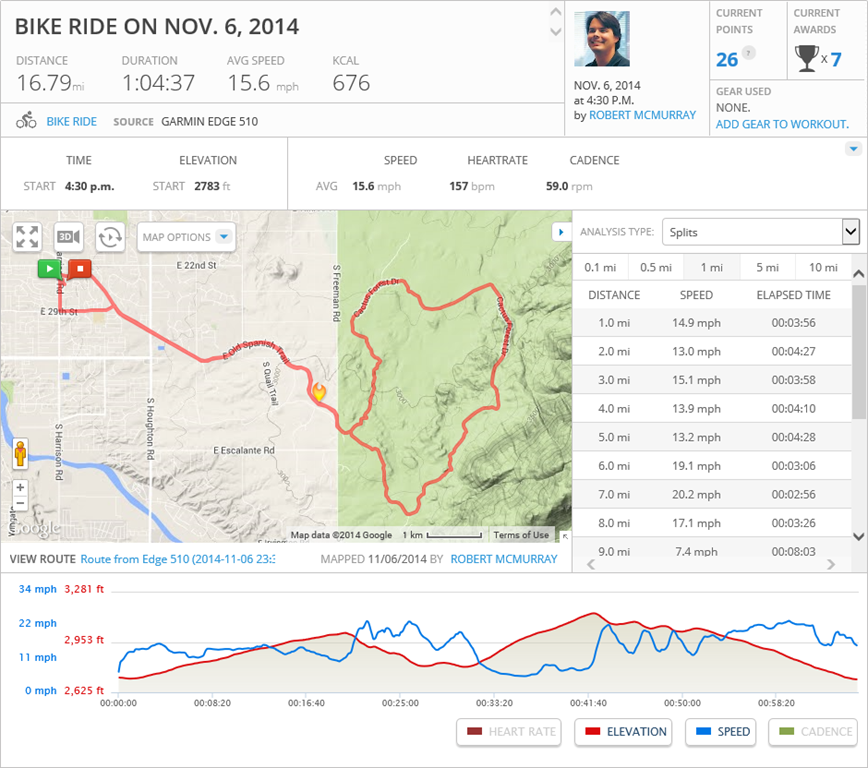
There were a few joggers and a single cyclist in the park, but no cars, which is always nice. (Trying to pass cars on the narrow, winding road through the park is no fun.)
I spent a lot of the time riding through the park focusing on hill training skills; for example, keeping my cadence higher by downshifting earlier. The big hill on Riparian Ridge pushed my heart rate higher than normal, as it always does, but for the most part my heart rate stayed below 160bpm.
Due to the earlier sunset these days, I was racing the daylight to get home before I was engulfed by darkness, but I managed to make it home just after the sun had descended over the Tucson Mountains to the west of town.
Ride Stats:
- Primary Statistics:
- Start Time: 4:30pm
- Distance: 16.8 miles
- Duration: 1:04:37
- Calories Burned: 676 kcal
- Altitude Gain: 823 feet
- Speed:
- Average Speed: 15.6 mph
- Peak Speed: 32.6 mph
- Average Cadence: 59.0 rpm
- Temperature:
- Average: 65.6 F
- Minimum: 62.6 F
- Maximum: 71.6 F
- Heart Rate:
- Average: 157 bpm
- Maximum: 174 bpm
Ride Notes for October 25th, 2014
25 October 2014 • by Bob • Bicycling
Some people climb Mount Everest without oxygen (which is stupid), and today I chose to ride two hours through Tucson and the Arizona desert without water (which is equally as stupid). Perhaps I should give you the details...

On Saturdays I usually have my long rides, which means that I typically try to ride for more than 40 miles. That being said, I have been on the email list for one of the local cycling shops, Sabino Cycles, for a couple of months. Their shop organizes weekly rides on Saturdays and Sundays, and I have never gone riding with them for two primary reasons:
- Their rides usually start around 6:00am
- They provide almost no details about their rides
Both of these reasons have usually been show-stoppers for me, because I have never been what you call a "Morning Person," (I usually go to bed around 2:00am and get up around 8:30am), and I don't like the idea of going on a ride that I know nothing about.
Note: Their emails usually contain information like, "This Saturday we'll ride our north route, and we'll leave the shop at 6:00am." That's almost nothing to go on, so I emailed the guy who organizes their rides to see if he could provide a map of their course routes with his emails. He replied that they like to change their rides, so he would prefer not to send a map. On a different occasion I have tried to explain to people who work in their shop that they would do better to at least say, "This Saturday's ride will be along Sunrise Drive through the Catalina Foothills, and we will probably ride somewhere around two hours or 30 miles depending on the pace and the weather. How hard is that? OK - I'll get off my soapbox.
Anyway, this week's email provided one piece of useful information: they were going to ride part of the El Tour de Tucson course, which I plan to ride next month. Their email said that today's ride was starting at 6:45am, which is somewhat closer to reasonable for me, so I set my alarm to get up early and ride with their group.
Unfortunately, I am who I am, so I was still wide awake and working on my computer at 3:00am when Kathleen got up to check on me. She asked if I was still going on the ride, to which I replied "Yes," and I eventually climbed into bed around 20 minutes or so later. Of course, that meant that it was quite the shock when my alarm went off at 5:45am. When you're working with only two hours of sleep, you make bad choices (like going on an early morning bike ride) and you tend to make mistakes (which I will get to later).
Nevertheless, I forced myself out of bed and I shuffled off through the house as I grabbed my gear and got ready to leave. I had set some things out the night before so I wouldn't be stumbling through our bedroom in the dark while Kathleen was sleeping. That helped out, but I still had some things to put together for today. I loaded several packets of Gu and a Cliff Bar into my bicycle's panniers, and I prepped four water bottles filled with Gatorade. I had wanted to hit the road by 6:00am because I knew that it would take a half-hour to get to the location where everyone was meeting, and I wanted to hit a McDonald's along the way to pick up an egg-white McMuffin to carb load for the ride.
Note: I missed my departure goal by a few minutes, but not by many. I stopped by the McDonald's according to plan, and this is one of those McDonald's stores with two drive through lanes that feed into one for expediency. As I pulled up, someone spoke over the intercom and asked me to wait while they took the order of the person in the other lane. I said, "No problem," and waited my turn. But after the other car had finished, there was a long pause after the next car pulled forward in the other lane. After a few minutes, the anonymous intercom voice took that car's order. Once it had pulled forward, the disembodied voice started to take the next car's order. By now McDonald's had wasted several minutes of my time and I didn't think that I would make the ride. But I was trapped in the drive through lane by several cars behind me, so I simply pulled forward. When I got to the window, the person started to rattle off someone else's order, and I explained that she had completely forgotten about me (and ostensibly everyone else in my lane). She profusely apologized, and I replied, "No worries - these things happen." I picked up my order within a couple minutes and got on my way.
It was still early in the morning, so there was little traffic, and as a result I sailed through Tucson and I arrived at the rally point near a coffee shop and bakery with a few minutes to spare. There were 30 or so cyclists who were there and ready to go, so I hopped out and started to get my gear ready as other cyclists arrived. I had worn a set of regular shorts over my cycling shorts, with the intention of stripping off the outer shorts before the ride. I had also set out one of my cycling jerseys the night before, so I reached into the back of the car - only to realize that I had failed to pack my cycling jersey in the car. (This was mistake #1.)
I thought to myself, "That's okay - I can wear the t-shirt that I'm already wearing, and since I don't have back pockets in a cycling jersey that I can use, I'll just bring two water bottles with me instead of four." It was then that I realized that I had also failed to bring the four water bottles that I had put together before I left the house. (This was obviously mistake #2.) All of those items were sitting safely and uselessly at home, so I thought that my chances of going on this ride were pretty much shot down in flames by my self-imposed fatigue and the terminal forgetfulness that was plaguing me as a result.
Nevertheless, I walked over to listen to the pre-ride briefing by the ride organizer, and as the group or 40 or 50 riders took off, I walked back to the car and weighed my options. I thought that I could call the whole affair a bust and head home, pick up my jersey and water bottles, and do some other ride. But I wanted to go over this leg of the El Tour de Tucson route, and I didn't want to miss this opportunity. Eventually I resolved to go on the ride without water. (This was mistake #3.) My reasoning was that I had several Gu packets, and I could stop for water if I needed to. To that end, I packed some cash and my debit card into my bike's panniers, just in case I would need them.
By this point the riders had been gone for several minutes, and as I hopped on my bicycle and sped after them, I realized that I had neglected to take off my outer shorts, so I was still wearing a set of shorts over my cycling shorts. (Crap. Crap. Crap. And that makes mistake #4.)
The group was far out of sight as I pulled onto the main road, and for the first mile or so I had to deal with the thought that I might not actually be riding the same route as the rest of the group, which meant that this ride might be a complete bust - again. I decided that if that scenario turned out to be true, I would simply ride for a bunch of miles and then turn around so I would at least salvage something of a decent ride out of my debacle.
As I sped down the road trying to locate the group, I noticed that my GPS was trying to tell me something. I read the status message on my GPS screen, which was telling me that it detected that I was moving - but I had never hit the 'start' button on the GPS to tell it that I had actually started my ride. (Dude? Seriously? Is your brain even working? Apparently not, and this was mistake #5.)
Shortly after I discovered my failure and hit the start button on my GPS, I remembered that I had brought my cellphone with me, where I have an app that I use as a backup GPS. Of course, I had packed the cellphone into my bicycle panniers, so I hadn't hit the start button on that, either. (Which brings us to stupid mistake #6.)
Somewhere about the two-mile mark I thankfully caught up to the group. Shortly after I pulled into the pack, someone had a flat tire, so the entire group pulled over while three or four people worked on the bike and quickly changed out the tire. As I was waiting, I noticed that the part of my GPS screen that should be displaying my heart rate was blank, and then I realized that I had failed to put on my heart rate monitor. (Um, that would be mistake #7, I guess.)
To be honest, the heart rate monitor is simply for curiosity - I don't need to have it, but it's kind of cool to look at my statistics after the ride, so this mistake wasn't all that bad. Anyway, I remember thinking to myself earlier that morning that I should put on my heart rate monitor before I left the house, but then I thought, "Nah, I'll get that later." Now I was several miles into the ride, and I figured that my heart rate monitor was probably sitting at home with my cycling jersey and water bottles. As I was mentally kicking myself for my never-ending comedy of errors, I suddenly remembered that I had put my heart rate monitor in the pocket of my shorts - the same shorts that I had failed to take off before I started the ride. (OK - failing to realize that I had the heart rate monitor with me the whole time is obviously mistake #8, but do I at least get credit for remembering to bring something? Does that negate one of the mistakes that I already counted?)
As I was putting on the heart rate monitor, one of the other cyclists in the group humorously remarked, "You know, you're not wearing a pretty cycling jersey like everyone else." I laughed and replied, "Yeah, it's sitting at home - with my water bottles." She laughed and said, "At least you remembered your helmet." (Taking everything else into account, it seems like a minor miracle that I didn't forget that, too.) Once the cyclists changing the tire caught up to us, the group took off again.
This was my first time riding in a group, and I was pretty happy that my pace seemed to be on par with the majority of the riders. That being said, there were some cool things that I noticed during the ride - most of the riders were great about calling out "On your left" as they passed, and they were great about pointing out hazards like debris in the road, approaching cars, braking for stoplights, etc.
I also learned that it was extremely bad to be stopped by a red light - because the group will be a good half-mile beyond you by the time the light changes in your favor again. However, the group's organizers were great about pulling the group to a halt now and again to let the group reform. This turned out to be extremely advantageous at one point, because I was somewhere between several groups of riders that were strewn across a mile or so of territory, and I pushed hard to catch a yellow light - which turned red as I cleared the intersection - thereby cutting me off from the group behind me. However, I was far enough behind the group in front of me that I lost them when they turned a corner at a subsequent intersection. In this section of town there were cyclists from all over who were making their way through this particular intersection, and I couldn't be sure which cyclists were part of the group that I was following. I took a guess and turned a corner, but I didn't see anyone that I recognized. By now I was thinking, "Oh great, I'm a good 15 miles from where we started out, I've never been in this part of the desert before, and I have no water." There were several houses around, so I wouldn't be completely out of luck if something went wrong, but as I zipped along I suddenly heard someone yelling, "Hey!" from a side street. As it turns out, our merry band of cyclists had pulled over to regroup again, and someone thankfully recognized me well enough to stop me from absent-mindedly riding past them as I sped off into unknown desert lands.
This turned out to be somewhere around the half-way mark of the ride, and it was mostly uneventful for the rest of the way back to the bakery. There was one big hill that we had to climb, which I don't think will be on the El Tour de Tucson route. A bunch of the riders had a hard time with it, so I was thankful that nearly all of my normal rides are hill workout rides.
I should point out that I also had to learn another riding skill: what to do when you're boxed in. I was riding faster than a small group of cyclists in front of me, but as I caught up to them, two cyclists pulled up on my left side and prevented me from passing. I tried to signal that I wanted to pull out, but the cyclists didn't pick up on that. (Which was probably due to my bad hand signals instead of any error on their part.) I decided to simply slow down, drop behind the gaggle of riders, then I pulled around the left side and pulled ahead.
As we started to approach our starting/ending point for the ride, I had been riding for nearly two hours with no water. Along the way I had consumed two packages of Gu to keep my electrolytes up, but there's little moisture in those. (Actually, Gu makes the inside of your mouth kind of slimy, so I usually wash them down with water). With that in mind, I didn't want to have another package of Gu, but I could really tell that my lack of water was beginning to take a serious toll on me. It was extremely difficult to climb small hills that I normally would zip over at a pretty good pace. As a result, I understandably dropped towards the back of the group, and I spent a lot of the time simply tucking my head down and continuing to pedal even though my legs were starting to scream out for some desperately-needed hydration. (Seriously - you can tell when this happens; it's not a good feeling.) As one of the other cyclists observed, "Sometimes you have to pretend that you're 'Dora' from Finding Nemo and 'Just Keep Riding... Just Keep Riding...'"
We were probably a half-mile from the finish when we stopped at a red light, and another cyclist in the group pointed to the empty water bottle cages on my frame as he asked, "Dude - do you need water?" I knew that we would probably finish the ride in the next few minutes, so I laughed it off and said, "No thanks, I think I'm good for the last part of the ride." Another rider replied, "You just need some coffee and a pastry," to which I enthusiastically agreed.
A couple of minutes later we pulled into the parking lot near the bakery, and as I unlocked our car, I remembered that I had some leftover coffee from earlier that morning - which I downed in a single gulp. Once I had my bicycle secured, I walked over to the bakery, where I proceeded to buy an enormous cup of iced tea and a mini-éclair, because I earned that darn éclair. (And I consciously wanted some sugar back in my system.) Once I had downed both of those items, I hopped in the car and I headed home for the day.
My moral to today's story? I need to put together a checklist before I do another ride like this in order to make sure that I don't leave any critical items sitting on the counter at home. (And yes, it would probably be better if I got more than two hours of sleep, but I can't count on that - my body just isn't wired that way.)
Ride Stats:
- Primary Statistics:
- Start Time: 6:54am
- Distance: Somewhere over 31 miles (see notes)
- Duration: 1:52:53
- Calories Burned: 1,214 kcal
- Altitude Gain: 1,283 feet
- Speed:
- Average Speed: 16.2 mph
- Peak Speed: 32.5 mph
- Average Cadence: 73.0 rpm
- Temperature:
- Average: 63.5 F
- Minimum: 55.4 F
- Maximum: 77.0 F
- Heart Rate:
- Average: 155 bpm
- Maximum: 174 bpm