When the Dream of Working for Microsoft was Far Beyond My Reach
05 May 2026 • by Bob • Microsoft
Way back in the early 80s, I was learning how to code on IBM 5150 Personal Computers in school, but I was poor and couldn't afford a PC of my own. Only my rich friends had actual PCs from IBM, so I had to make do with 6502-based computers from Commodore and Atari. Back then everyone knew about IBM PC DOS, because that's what you needed to use your PC, but few people knew who Microsoft was.

Jumping ahead to the late 80s, I was in the military and stationed overseas. Purchasing a new PC was still far too expensive for my measly salary, so I bought a dead PC from a coworker for $50, and it cost me $5 in parts and an hour of soldering to get it running. By then most geeks knew about Microsoft, and as such I installed MS-DOS 4 instead of PC DOS. I was remarking to my wife how much better MS-DOS 4 was than the PC DOS I had been using nearly a decade earlier, and she said, "Wouldn't it be cool to work for Microsoft?," to which I responded, "Yeah, that'll never happen."

A few years later I was out of the Army and working in the IT department of a small college in Tucson, AZ, and we loved Microsoft. Licensing fees for Lotus 1-2-3, Ashton Tate's dBASE III, and WordPerfect 5.1 were eating up our school's IT budget, and we had little money left to repair our aging computers. When Microsoft came along and offered to license all of Microsoft Office for Windows for less than a license for any single competitor product, we jumped at their offer, and suddenly we had an IT budget again. Like I said, we loved Microsoft.
After the launch of Windows 95, Microsoft announced that they were going to open a technical support center in Tucson, and I didn't think I had a snowball's chance in hades to land a job there. My opinion was reinforced when I showed up to Microsoft's job fair on October 4, 1995, and I saw how many people had turned up for the event. The numbers were staggering: Microsoft wanted to hire 100 people initially, and 8,000 Tucsonans applied for jobs.
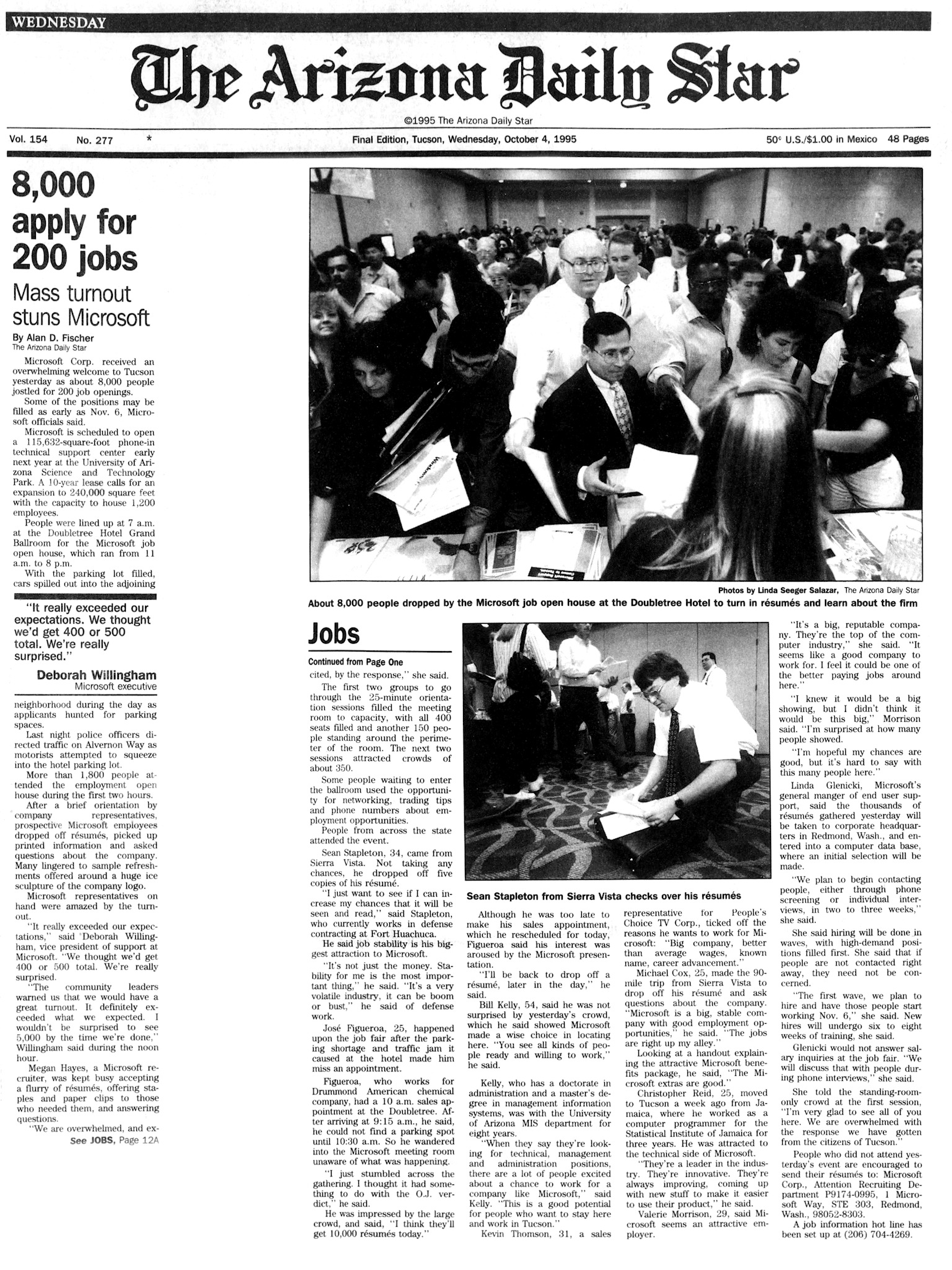
I attended Microsoft's job fair with a couple guys I knew from my time in the Army, and we stood in the back of the room gazing at the assembled crush of people. At some point one of our group muttered, "Well, none of us are getting hired," but we nevertheless dropped off our resumes and left, albeit a little demoralized. Oddly enough, however, all three of us were hired. I immediately said "yes" to Microsoft's offer when they called me, and I offically began my career with the company in December of 1995. That was over 30 years ago, and I'm still proud to call Microsoft my "home."

Looking back over the past few decades, I've had an amazing career at Microsoft, and despite the occasional annoyance of a bad manager or two, I've had a lifetime of great experiences wearing a Microsoft "blue badge." Microsoft was my dream job long before I interviewed with them, and my reply to everyone who has asked me what it's like to work for Microsoft has always been, "It's like working for Santa Claus. We make all the best toys, and we get to play with them before anyone else."

POSTSCRIPT:
One other thing - I was about to be hired by Artisoft (makers of LANtastic) when Microsoft made me their offer. At the time, I struggled with the decision of which offer to take, and all these years later I'm REALLY glad I came to my senses.

When Microsoft NetMeeting Saved the Day
09 February 2026 • by Bob • Microsoft, Technology
In the late 1990s, I was delivering training for a large group of external business leaders in downtown Dallas that was organized by Microsoft's marketing team, and my presentation was supposed to be broadcast to remote Microsoft learning centers across the country using Cisco's video teleconferencing hardware.
As the time for the training to begin drew near, it was clear that the Cisco hardware was failing completely, and techs were scrambling to fix the problem, lest the expensive training session be canceled.
While the Cisco techs worked feverishly, I placed a Polycom conference phone on the speaker podium and used it to call the other learning centers. I told the people running the show at each location that I was firing up Microsoft's NetMeeting, then I gave them all my IP address and asked them to connect to me. I shared my desktop through NetMeeting, then I suspended a microphone over the Polycom phone so that everyone in the Dallas location could hear anything that was said at the remote locations. After a quick sound and video check with all the remote locations, we were in business.
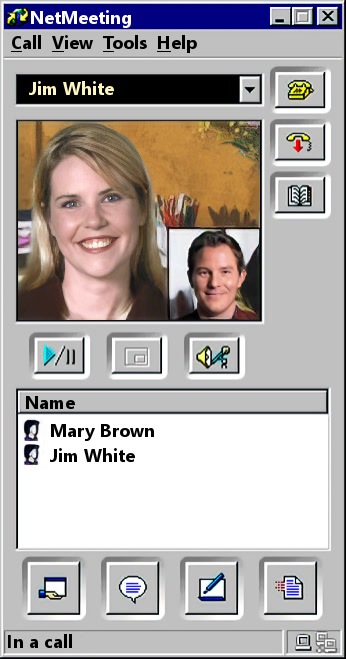
As soon as I had everything ready-to-go through my unorthodox workaround, I turned to the Dallas audience and said, "You've just witnessed the successful deployment of a Microsoft software solution for a third-party hardware failure in real time." The audience erupted with applause, and the marketing folks at the back of the room who had organized the event were beaming with pride.
The rest of my presentation went off without a hitch, although the Cisco techs never got their hardware to work.
Of course, Microsoft NetMeeting is long gone, but in it's day - it was a handy, little piece of software that did amazing things.
Troubleshooting Tales: Rebooting Microsoft Surface Takes Several Hours
30 January 2026 • by Bob • Windows, Troubleshooting, Microsoft
I ran into an interesting troubleshooting situation that I felt was worth sharing, because it serves as another example of why original assumptions when troubleshooting a misbehaving computer might not be accurate.
Here's the problem description: I had a Microsoft Surface laptop from my employer that worked fine for a while, but over time it began to take anywhere between 3 to 12 hours to cold boot or reboot, which made powering off the computer or installing Windows Updates an extremely painful experience. (Note that the boot times were approximate as I never tried to time a reboot or shutdown/restart.) Whenever the Surface started, the screen would be black, but if I touched the touchpad or pressed a key on the keyboard, the keyboard would light up to show that the computer was running, but nothing would happen for several hours. Then without warning the machine suddenly would wake up and everything would be fine.
Of course, trying to troubleshoot what might be wrong was an extremely unproductive experience, because anything I tried would always take several hours to check. I'll spare everyone the sordid details, but in my efforts to troubleshoot the issue, I tried all sorts of things like configuring several Windows services for delayed start and various performance-related settings, and all with no success. To workaround the slow startup behavior, I never rebooted this laptop for anything other than Windows Updates - I would always hibernate the computer instead of shutting it down. In the meantime, I had an HP desktop computer that worked great - it always rebooted with no problems.
I eventually decided that my Microsoft Surface was unreliable (and often unusable), so I requested a replacement from my employer, and I was sent another Microsoft Surface laptop. However, shortly after I received the new computer, the same behavior started happening. I spent a lot of time searching for users who had experienced similar behaviors with a Microsoft Surface, and I compared dozens of settings between my HP desktop and Microsoft Surface, and lots of other things that I won't bother boring you with. And all the while my HP desktop computer continued to reboot as expected.
Though I should mention that as a troubleshooting step, I reinstalled Windows from scratch on one of the Microsoft Surface laptops. My employer uses Microsoft Entra ID for federated user authentication and group policy, but I didn't initially rejoin this computer to Entra ID after reinstalling Windows, and the reboot problem went away - until I rejoined it to Entra ID. The problem returned after I rejoined the Microsoft Surface laptop to Entra ID, although I wasn't having any problems with my HP desktop computer that was also joined to Entra ID, so I theorized that the underlying issue might be something in Group Policy that was causing problems only with Microsoft Surface laptops, and this theory became yet another avenue for troubleshooting.
However, one day I had an epiphany: what if the issue that I was experiencing didn't have anything to do Microsoft Surface laptops? With that thought in mind, I abandoned the train of thought that I had been pursuing and - to make a long story short - I soon discovered the article Microsoft Entra joined computers experience a three hours delay during boot, which contained the fix that resolved the problem, and I'll explain the details:
What was going on was that even though all my computers were joined to the Entra ID domain, the network settings on my Microsoft Surface laptops were configured to use the NETBIOS name for the Entra ID domain as the "WORKGROUP" name instead of something else. When this happens, Windows will enter a wait state for 10,000 seconds, which is 2 hours and 47 minutes, and in my observation I witnessed Windows re-entering that wait state for two, three or four times, which would respectively be 5.5 hours, 8.3 hours, or 11.1 hours, which explained the "anywhere between 3 to 12 hours" symptom that I described earlier.
As soon as I updated the workgroup name to something else, my Microsoft Surface laptop rebooted in a matter of seconds like it was supposed to.
I'd like to say that I managed to resolve this issue over the short span of a few weeks, but... no. Since this only happened with my Microsoft Surface computers and not my HP desktop computer, I spent over a year thinking that this was some sort of problem that was specific to Microsoft Surface computers and attempting to troubleshoot the issue from that perspective, when that was never the case.
Darn.

30 Years at Microsoft
18 December 2025 • by Bob • Microsoft
Ok, sure - I freely admit this post is 100% self-aggrandizing, but today is my official 30-year anniversary with the company. It seems like only yesterday when I was hired as a tech support engineer for Microsoft Access 95.
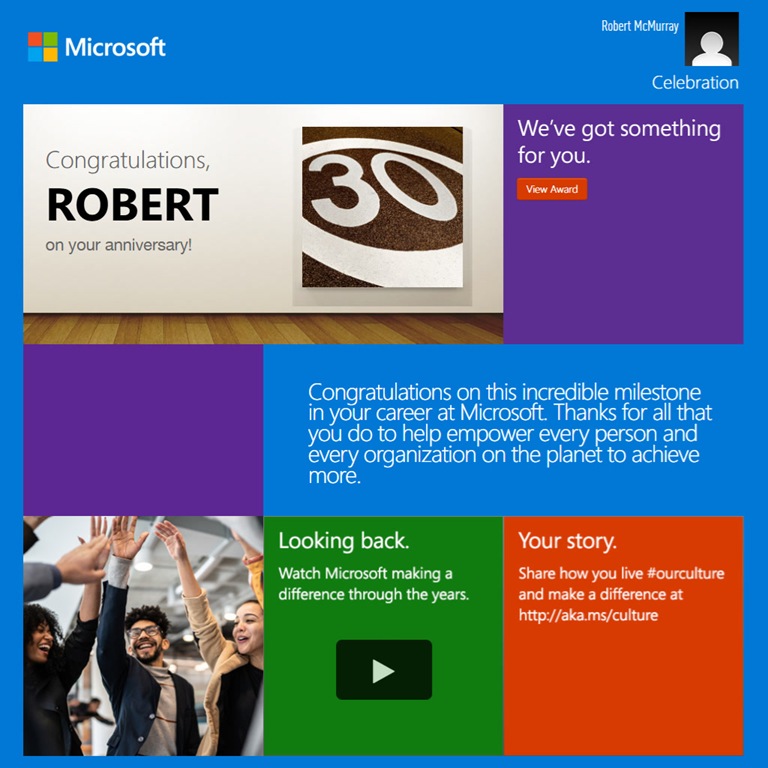
These past 30 years have been a great ride, and I hope I have more years to come.
(There was a time when employees who were celebrating their 10, 20, and 30-year anniversaries could look forward to a celebratory dinner hosted by the company in Redmond, but those days have long-since passed. C'est la vie.)
POSTSCRIPT:
I will admit that this post, much like my 25 Years at Microsoft post, is somewhat brief. But if you're curious, I wrote a detailed summary of my earlier history with the company in my Some Thoughts About My 20th Anniversary At Microsoft post. (Wow. I wrote that ten years ago. Where has time gone?)
Office Moves on Microsoft's Main Campus
11 July 2025 • by Bob • Microsoft
Office moves at Microsoft's Redmond campus are as ubiquitous as overcast skies and traffic on the 405, and several years ago I took an overhead photo of the old main campus and highlighted all the buildings where I'd had a physical office at one time or other.
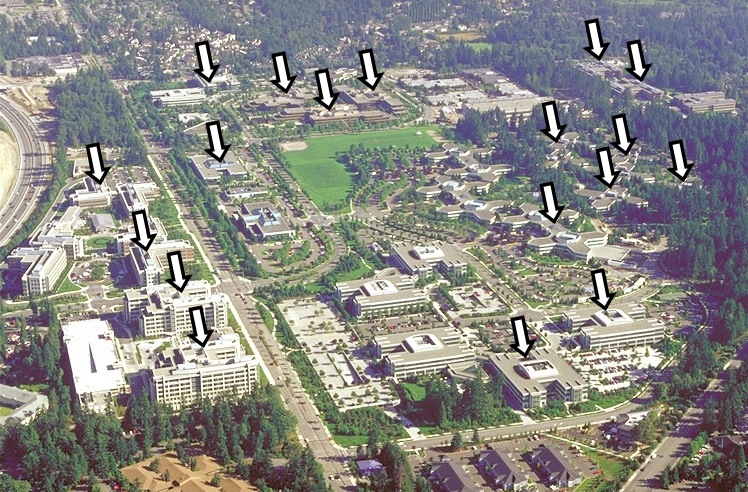
Bear in mind, however, that this photo only has buildings 1 through 44, and I worked in some of the 50-59 buildings, too.
Not All Marginalization is Misogyny
10 July 2022 • by Bob • Computers, Apple, Microsoft, Technology, Rants
Every few years, the following photograph of Margaret Hamilton makes the rounds in social media. This particular image's popularity is not surprising; it's a great shot of Hamilton, who was NASA's lead developer for Apollo program, standing next to the stack of computer printouts for the software that told the Apollo Guidance Computer what to do and when to do it, which eventually helped astronauts land on the moon.
#/media/File:Margaret_Hamilton_-_restoration.jpg "Margaret-Hamilton-With-Apollo-Software")
A friend recently posted this image to social media, and upon seeing it, someone else responded, "That is incredible. Why haven't I ever heard of her before?"
My friend's reply was simple: "Because men."
I completely understood my friend's point. There are far too many times when women are overlooked in their respective fields. But I was annoyed and frustrated by my friend's
In some fields, men are easy targets for a good round of bashing where "popularity" or "fame" are concerned, but when an entire career field isn't "popular," then EVERYONE who works in that field remains obscure. As history shows, Hamilton (and Hopper, and Sammet, and Allen) earned a host of accolades, but most people haven't heard of them because we use their work without giving a second thought where it came from. (Which, by the way, is true of all engineering fields, but I digress.) I challenge anyone to name a single engineer - man or woman - who helped to produce the iPhone, which is (for better or worse) one of the most civilization-altering inventions in history. Oh, sure - everyone can name Steve Jobs, because he owned the company. But Steve Jobs never "made" anything; millions of unnamed engineers - both men and women - are responsible for the iPhone, the iMac, Windows, Google, Microsoft Office, etc.
Here's another example: I just watched the new "Thor" movie, and Taika Waititi's name is everywhere during the credits because he co-wrote and directed the movie; but most people probably haven't heard of his co-writer, Jennifer Kaytin Robinson, because "men." (Hollywood has always been and continues to remain misogynistic, but once again I digress.) However, did anyone bother to pay attention when the credits listed hundreds of people who worked on SFX/CGI for the movie? Nope - we enjoyed their work, but the computer scientists and digital artists who contributed to every scene in that movie remain unknown to anyone outside of their field.
Looping this back to the original subject of NASA and whether they slighted Margaret Hamilton, can anyone name any of the other members of her software development team? If the entire reason some people haven't heard of her was "because men," then I would assume that people could name some of the men who were on her team because they would have received credit for her work. But no, people can't name any of them, either. And why is that? Because - engineers.
How about any of the men and women who designed the Apollo space capsule? Or the Lunar Rover? Or the space suits? Or the propulsion systems? Or the communication systems? Or anyone involved in Skylab? Or the Space Shuttle? Or the Mars probes? Once again, people can't name a single one of those people. And why is that? Because "engineers."
NASA isn't slighting anyone. On the contrary, NASA hires brilliant minds - both men and women - who remain unknown to the general public because they chose extremely technical career fields that lead to obscurity within the community, and societal anonymity doesn't care about gender when it comes to scientific ignorance...

The Day I was a Sports Legend
22 October 2021 • by Bob • Humor, Microsoft
Back in my early days as a Technical Support Engineer at Microsoft, my boss had a dartboard outside her office, and several of our fellow team members would play darts on their breaks. I suck at darts, so I never joined them.
One day I happened to be walking by, and one of the guys asked, "Why don't you ever play with us?" I replied, "You wanna see why?," then I grabbed one of the darts and threw it with barely a look in the direction of the dartboard.
I fully expected to miss the board by several feet, and thereby demonstrate to everyone my complete lack of skills. However, by some miracle the dart landed dead center in the bull's-eye. Rather than show everyone my expression of dumbfounded surprise, I quickly collected myself, then I turned to the people gathered around and asked with a feigned air of superiority, "Do you REALLY want a piece of me?"
Then I walked off, leaving my stunned coworkers in awe while I basked in the glow of a victory that I could never have achieved if I had tried, and like any great athlete - I left the sport at the top of my game.

25 Years at Microsoft
19 December 2020 • by Bob • Microsoft
Today marks my official 25-year anniversary with Microsoft. I've had a blast, and I've had the privilege to take part in some pretty amazing projects. I can honestly say that several of the products that I helped design are running on millions of systems around the globe, and I worked with some amazing people to bring those ideas to life.
These past years have been great, and I hope that I have many more to come.

POSTSCRIPT:
If you'd like to see some of my personal history with the company, here are several videos that I recorded for Microsoft over the years.
NOTE: These videos were originally on Microsoft's Channel 9 website, which has been retired. As such, these videos are coming from the Internet Archive, so they make take longer to load than expected.
Flight Simulator 2020: First Impressions
27 November 2020 • by Bob • Reviews, Gaming, Microsoft, Troubleshooting
I've been a fan of Microsoft Flight Simulator (MSFS) since it was first introduced. (Or even earlier if you count SubLogic Flight Simulator that preceded it.) I have owned every version of MSFS, and I usually rushed out to buy each version when it hit the stores.

I would have to say, though, that my favorite version had been Flight Simulator X (FSX), which was released in 2006 - the levels of detail and realism were amazing. Unfortunately, FSX was the final version of MSFS. Microsoft chose to unceremoniously kill off MSFS in 2009, and like every other MSFS fanboy, I was quite upset to see it fade into the sunset. There were a few failed attempts to breathe life into the franchise via Microsoft's Flight and Steam's rerelease of Flight Simulator for their gaming platform, but each offering fell far short of the goal.

Needless to say, I was thrilled when I heard the news that Microsoft was reviving the series with Flight Simulator 2020, which promised unbelievable video quality and unparalleled realism. As I had done with every previous version of MSFS, I bought FS2020 on the day of its release and installed it immediately. As soon as the installation was done, I launched the application to see - nothing. MSFS displayed a message to inform me that my GeForce 9800 GTX video card was not powerful enough to run FS2020.
This was disappointing, to say the least, but I wasn't too worried - because I had already purchased an NVIDIA GeForce GTX 1070 video adapter for my computer. However, I had too many tasks competing for my limited time, so I had to delay the installation of my new video card. That being said - today was the day! I powered down my system, swapped out the old video card for the new card, and rebooted. As soon as the operating system was up and running, I launched FS2020 and was excited to see - nothing. Well, not exactly nothing; what I saw were two error messages:

Connection Lost - Please ensure you have an active internet
connection, and check the forums for additional information.
-and-

Access to the content servers is currently unavailable. Please
ensure you have an active internet connection, and try again later.
Please visit https://flightsimulator.zendesk.com/ for additional information.
Unfortunately, those error messages sent me into an endless loop that always resulted in my seeing these same messages again and again; and since there was no other way to exit the application, I had to hard kill FS2020 using the Windows Task Manager. I followed the advice from the error messages and I checked the forums, where I found the following two threads that described my exact situation:
Installation error after update
-and-
Access to the content servers is currently unavailable error message
I tried everything that was suggested in both of those threads (as well as suggestions from several other forum threads and blog posts), but so far - no luck. I still have yet to see anything from MSFS2020, but I'll keep looking.

With that in mind, here are my first impressions of Microsoft Flight Simulator 2020:
- Game Experience = I have no idea. I have yet to see the actual game.
- Installation Experience = terrible. The minimum requirements are excessive, and when an end user can't get a game to run as soon as they're done installing it, that's a catastrophic failure for which the game designer is solely responsible.
- Troubleshooting Experience = terrible. End users are pretty much on their own when something fails. Microsoft's single troubleshooting recommendation is for users to check the forums, which is way below par for a major software product from a major software company.
On a related side note, I installed MSFS2020 using the Microsoft Store application for Windows 10. That app is relatively easy to use, but it could be a lot better in my opinion; I often find myself highly annoyed at how difficult it is to find apps that I know have been released and install them.
This Scammer Picked the Wrong Geek to Mess With
08 December 2016 • by Bob • Microsoft, Support, Windows
What a great way to start my day. I just received a call on my work phone from an anonymous number where a guy with a thick accent on the other end of the line began his pitch by claiming, "This is Windows Technical Support. I am calling you today because we have been receiving a bunch of messages from your computer which are telling us that..."

Hehe... seriously? This clueless dude had no idea he was dealing with a Microsoft employee. But then again, I had a busy day planned, so I had no time for squabbling.
I quickly cut him off and said, "Look, I can save us both a bunch of time. Do you know who I work for?"
The would-be con man was immediately taken aback and momentarily at a loss for words, but he managed to eke out a hesitant "No" as a reply.
I continued by saying, "I work for Microsoft."
The scammer attempted to regain his composure and started to reply with, "Oh, then you must know..."
I cut him off again and I asserted, "Yes, I do know. I have worked for Microsoft for over 20 years, and I know that Microsoft does not call customers like you are doing. You are a liar. And what you're doing is illegal."
Predator had turned to prey, and the hapless dolt on the opposite end of the phone began to mumble, "Honestly, sir, I... uh..."
And then I heard nothing but dial tone.
Yup, that was a great way to start my day.